
I was watching a comedy show the other evening and the comedian was complaining about how shoe sizes don’t make any sense. Being a person who thinks about the way we set values to things, I saw the connection between shoe sizes and design tokens: how we set up a particular scale that works for the moment, and then over time realize how messy it has become, and by then it is too late to change. Adoption is just a matter of how the manufacturers agree and consumers don’t have much of a choice.
History of shoe sizes
As you might imagine, in the beginning there were no shoes. The first “shoes” were sandals. No top covering, just something to protect the bottom of your foot. Eventually, protecting the top of the foot also became important, and experimenting with how that might happen led to the first shoes.
When thinking about manufacturing shoes, this was largely limited to the wealthy. Creating well-made shoes was expensive and time-consuming but most importantly custom. The shoe was made to fit that particular foot. There was no need for a standard because the shoe-maker would measure the foot accurately and transfer those measurements to the production of the shoe. Each was bespoke and unique.
It was around this time that measurement standards were becoming necessary, not just for shoes but for other things. The Welsh Laws of Hywel Dda stated that three barleycorns made an inch but King Edward II is said to have popularized the barleycorn unit of measurement: one third of an inch, or about 8.47 mm. That one-third of an inch became the first step for each shoe size. Later, a guild of shoemakers in England agreed on a quarter-inch scale for shoe sizes. And the sizes we see in many places today, which include widths and half sizes, came around 1880. This was quickly approved by the US Retail Boot and Shoe Dealers’ Association, but slow to be adopted due to the number of lasts that needed to be made.
There are two systems that don’t use the last and instead measure the foot directly. Japan’s system measures the foot in centimeters with no separate systems for men, women, or children. Similarly, the Mondopoint system is measured in millimeters and is an ISO standard (ISO 9407). This happened because NATO needed to supply boots to many different countries and needed a standard that could be used across all of them. Ski boots are often sold in Mondopoint sizes.
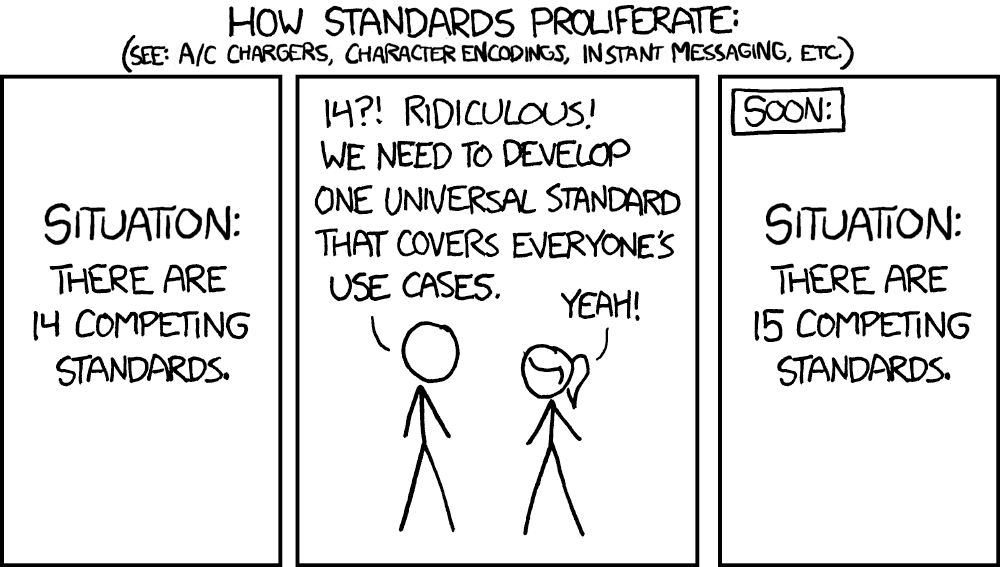
This might immediately remind you of the XKCD comic for competing standards.
The relation to design tokens
Before the shoe sizes, shoes were bespoke. Only made for the place they were to be used, on one individual’s specific feet. In the case of theming on the web, this was also true. We’d hard code the colors in place because every website was also specific to the brand with no other influences. The pain of making a new style was costly and only available to the folks who had the resources to invest in another custom look.
What opened this up to more people was introducing a scale, but more so a sharable language. Shoemakers and consumers alike would share the scale. A person could now know they were a size “8” and could more easily select a shoe that would most likely fit. Importantly, this sharable language was not globally accepted, but instead other regions made their own for the same purpose. Was the barleycorn a good unit of measurement? In retrospect, probably not. Hindsight tells us that a more universal unit of measurement would have been better. However, it was clear that a need arose and the barleycorn filled that need.
The same is true for design tokens. This is where token bloat comes from. It comes from the needs of an individual organization and looking to solve the problem in what makes sense to this particular group. It’s also why we’ve seen articles for years about how one company has outlined their tokens and how they differ from another company’s. And this is also why I’ve been so passionate about trying to understand what a standard for this might look like. That research became the book Mise en Mode positioned as a way for all teams to share a common language for design tokens.
What this triggered for me
Half-sizes are the smedium problem. It is designed with an oversight. It’s a scale that wasn’t prepared to handle the needs of the future. It was designed for the needs of right now. This is what makes shoehorning (pun intended) new notches of the scale so messy. Seeing that there’s a thoughtful standard for shoe sizes gives me hope that we can also have thoughtful standards for other things but also seeing the current state of standards makes me disappointed in the reality. For some, the creation of a new token naming system seems like an achievement, one worth writing about in many articles across the web. But in my view, I wish we had the resources to really come together and standardize this. If not for us, then for the big, shared LLMs that hallucinate someone else’s set of tokens.
Then maybe, just maybe, we can really start sharing expressions between experiences for an inclusively better world… with just one more standard, I swear. 😅